
Few social media myths are repeated with more confidence than this: once you pay to promote a TikTok post, the platform deliberately reduces your organic reach so you will keep spending.
It is an appealing explanation for a disappointing graph. It is also unsupported by the evidence TikTok makes public.
TikTok has never documented advertising history as a negative organic-ranking signal. Its recommendation system is built around something far more valuable than whether a brand has previously opened its wallet: how people respond to each piece of content.
According to TikTok’s explanation of its recommendation system, distribution is influenced by signals such as viewing behaviour, likes, shares, comments, searches and the information contained within a video. Watch time matters. Completion matters. Relevance matters. A viewer choosing to skip matters.
“This account has advertised before” does not appear as a published reason to restrict its next organic post.
So why does the myth feel so convincing?
Because paid reach creates a temporary rise in distribution. While a campaign is active, TikTok is being paid to place the content in front of additional people. When the campaign ends, those purchased impressions stop. The resulting graph can look dramatic—but the decline is usually the removal of paid delivery, not evidence of an organic punishment.
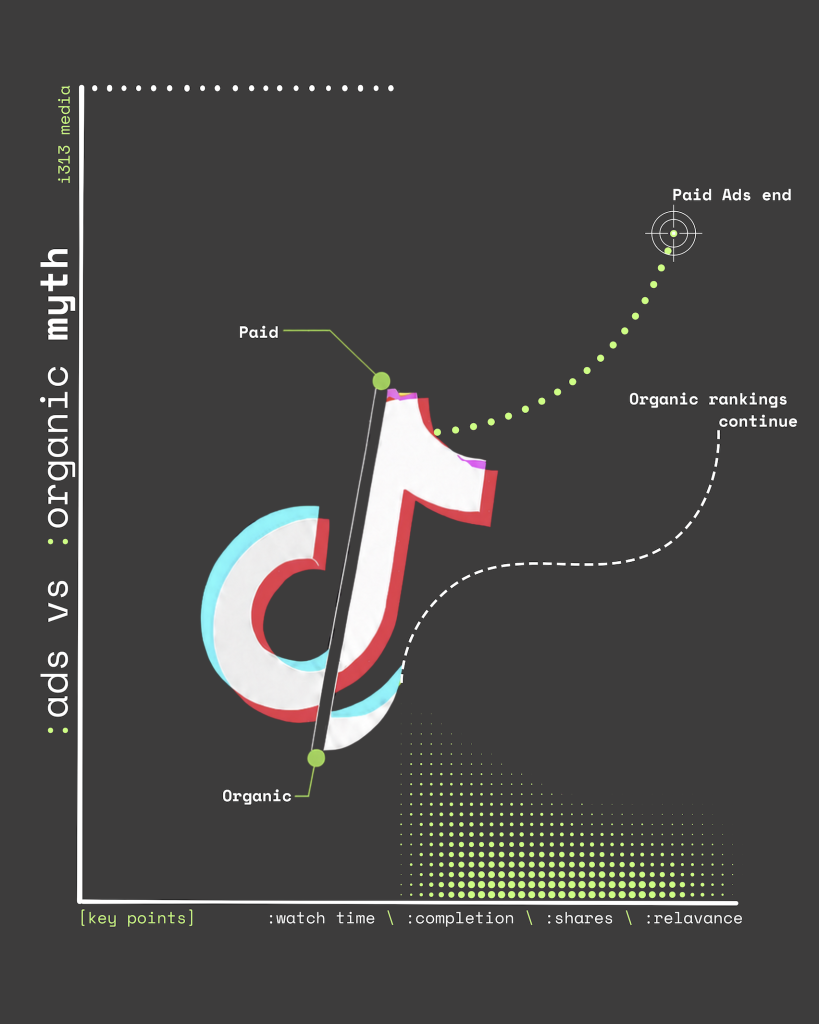
[The tap has been turned off. The well has not been poisoned]
There is, however, an important distinction. Paid and organic activity are not completely sealed away from one another.
Promotion can introduce a post to a broader or less naturally interested audience. It can attract new followers, alter the mix of people engaging with the account and change the overall numbers attached to the content. With Spark Ads, TikTok states that the views, comments, likes, shares and follows generated during promotion are attributed to the original organic post. That creates useful social proof, but it can also make the performance appear more organic than it really was. TikTok explains this directly in its current Spark Ads guidance.
That is an attribution issue, not an algorithmic grudge.
A promoted post may also perform poorly because its creative was never strong enough to hold attention. Advertising can purchase an opportunity to be seen; it cannot purchase genuine interest. If people scroll away, the problem is unlikely to be that the account advertised. More often, the hook was weak, the audience was wrong or the content failed to reward the viewer’s time.
The strongest strategy is therefore not to choose between paid and organic, but to give each a clear purpose.
Publish organically. Watch how people behave. Identify the videos that hold attention, earn meaningful engagement and communicate the brand naturally. Then use paid distribution to amplify the strongest ideas, reach a more precise audience or test whether a creative concept can scale.
Measure the two channels separately wherever possible. Look beyond the headline view count and examine watch time, completion, shares, profile visits, conversions and the source of the traffic. Otherwise, purchased visibility can easily be mistaken for organic momentum—and its disappearance for suppression.
Paid TikTok activity does not rescue uninteresting content. Nor is there credible public evidence that it poisons good content simply because money was spent.
The algorithm does not hold a grudge. It follows attention.
[Paid reach ends. Organic ranking continues. And every new post must still earn its place in the feed]